What Happens When a Builder Abandons a Job?
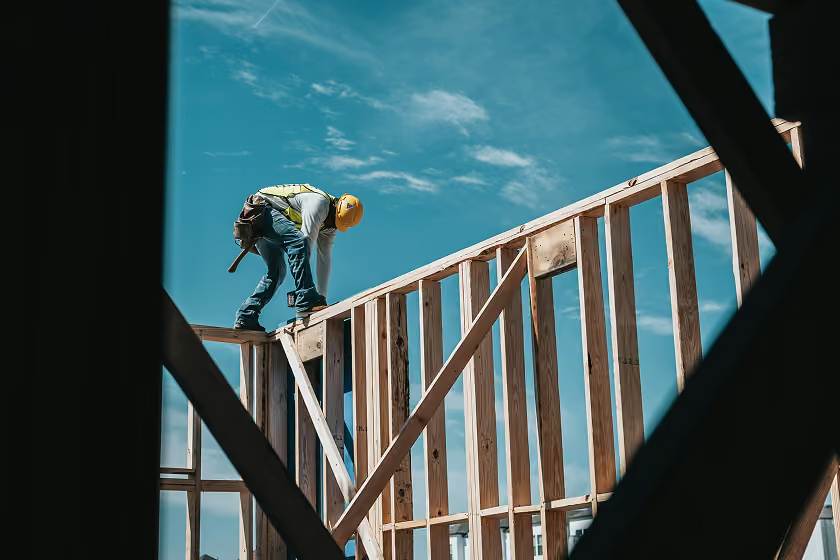
You have paid the deposit. The building work has started. Then, suddenly, the builder stops turning up.
The phone calls go unanswered, work on site has come to a standstill and you are left with an unfinished home and no clear idea of what happens next.
Unfortunately, builder insolvency, disappearing builders and incomplete building work can leave homeowners facing significant costs and uncertainty.
So, what can you actually do if your builder abandons your project?
First, work out exactly what has happened
A builder being absent from site for a few days does not necessarily mean they have abandoned the project. There may be a legitimate delay, an extension of time under the Contract, a supply issue or another circumstance affecting the works.
However, if the builder has stopped work, failed to communicate, missed contractual deadlines or indicated that they will not return, you should address the situation promptly. Start by reviewing your building Contract and checking:
- the agreed completion date;
- any extension of time provisions;
- progress payment requirements;
- termination provisions;
- procedures for dealing with defective or incomplete work; and
- any dispute resolution provisions.
Keep copies of all emails, text messages, invoices, payment records and other communications with your builder.
Can you terminate the Building Contract?
Potentially, but termination should not be treated lightly.
The right to terminate will depend on the terms of your particular building Contract, the nature of the builder's default and the circumstances surrounding the project.
NSW Fair Trading provides guidance and model home building contracts, but builders may also use their own contracts or contracts prepared by industry bodies such as the Housing Industry Association (HIA), provided the contract complies with the requirements of the Home Building Act 1989 (NSW).
The particular Contract you signed is therefore important.
For example, a residential building Contract may contain a process for dealing with certain builder defaults. Depending on the terms of the Contract and the nature of the default, this may involve giving the builder written notice requiring the default to be remedied within a specified period before the homeowner can exercise a right to terminate.
If the builder has genuinely abandoned the project, the appropriate steps will depend on the Contract, the reason for the abandonment and the circumstances surrounding the work.
Do not simply assume that because the builder has stopped attending site, you can immediately terminate the Contract and appoint someone else.
Incorrect termination can itself have legal consequences.
What about incomplete or defective work?
The Home Building Act 1989 (NSW) contains statutory warranties that apply to residential building work.
Among other things, the builder warrants that the work will be performed with due care and skill, comply with the relevant plans and specifications, comply with applicable laws and be carried out with due diligence and within the time stipulated in the Contract or, if no time is stipulated, within a reasonable time.
These protections can be particularly important where a builder walks away from a project. You may be dealing with both incomplete work and defective work, and it is important to properly document the condition of the property before another Builder begins rectification or completion works.
Get the site documented
Before another builder starts ripping out, repairing or completing the existing work, consider obtaining photographs, videos and, where appropriate, an independent building inspection or expert report.
Why?
Once another builder starts work, it may become more difficult to establish exactly what the original builder did, what was incomplete and what defects existed before the new work commenced. A proper record can be extremely useful if you later need to pursue the original builder for the cost of completing or rectifying the works.
What if the builder has disappeared or gone broke?
This is where Home Building Compensation (HBC) cover may become particularly important.
For eligible residential building work valued at $20,000 or more, HBC cover is compulsory. The scheme can provide protection where a builder cannot complete the work or rectify defects because, among other things, the builder has become insolvent, died, disappeared or had their licence suspended in certain circumstances.
If you have HBC cover, check your certificate and contact the relevant insurer promptly. NSW Fair Trading recommends notifying the HBC insurer as soon as possible because delays in making a claim can affect your position.
It is also important to remember that HBC cover is not simply a replacement for pursuing contractual or statutory rights against the builder. The availability and extent of cover will depend on the circumstances and the requirements of the scheme.
How long do you have to make a claim?
The Home Building Act provides statutory warranty periods of:
6 years for a breach resulting in a major defect; and
2 years for other breaches.
Importantly, where the complaint concerns incomplete work, NSW Fair Trading states that the relevant period commences from the date the Contract is terminated or, where the Contract has not been terminated, the date the work ceased.
There can also be an additional six-month period where the breach becomes apparent during the final six months of the applicable warranty period.
These time limits make it important not to leave an abandoned building project sitting unresolved.
What should you do next?
If your builder has stopped work, consider taking the following steps:
- Review the Contract.
Understand the builder's obligations, completion dates, termination provisions and dispute resolution process.
- Stop and check before making further payments.
Progress payments should generally correspond with work completed in accordance with the Contract. NSW Fair Trading recommends that homeowners only make authorised progress payments.
- Document the property.
Take photographs and videos and consider obtaining an independent report.
- Check your HBC cover.
If the builder has disappeared or become insolvent, determine whether you have a potential claim.
- Put the builder on notice.
Depending on the circumstances and Contract, formal written correspondence may be appropriate.
- Obtain legal advice before terminating.
Termination can have significant consequences, particularly where substantial work remains outstanding.
What if the builder simply refuses to come back?
You do not necessarily have to remain stuck indefinitely.
NSW Fair Trading provides a complaint handling and dispute resolution service for eligible residential building disputes. Depending on the circumstances, Fair Trading may investigate the complaint, facilitate resolution or issue a rectification order. If the dispute cannot be resolved, proceedings may ultimately be brought in the NSW Civil and Administrative Tribunal (NCAT).
The important point is to act before the situation becomes more expensive to fix. An unfinished building project can quickly lead to additional accommodation costs, delays, additional building costs and disputes over defective work. The earlier the Contractual and statutory position is properly assessed, the more options you may have.
The Lawgix takeaway
A builder walking away from your project is stressful, but you should resist the temptation to immediately terminate the Contract, engage another builder and hope everything sorts itself out later.
Your building Contract, the Home Building Act 1989 (NSW), HBC cover and the evidence of what happened on site can all affect your rights.
If your builder has stopped work, disappeared or is refusing to complete the project, getting advice early can help you understand your options and avoid turning an unfinished build into an even bigger legal dispute. Reach out to Lawgix on 1300 529 449 to book a 15-minute complementary consultation with our experienced solicitors.